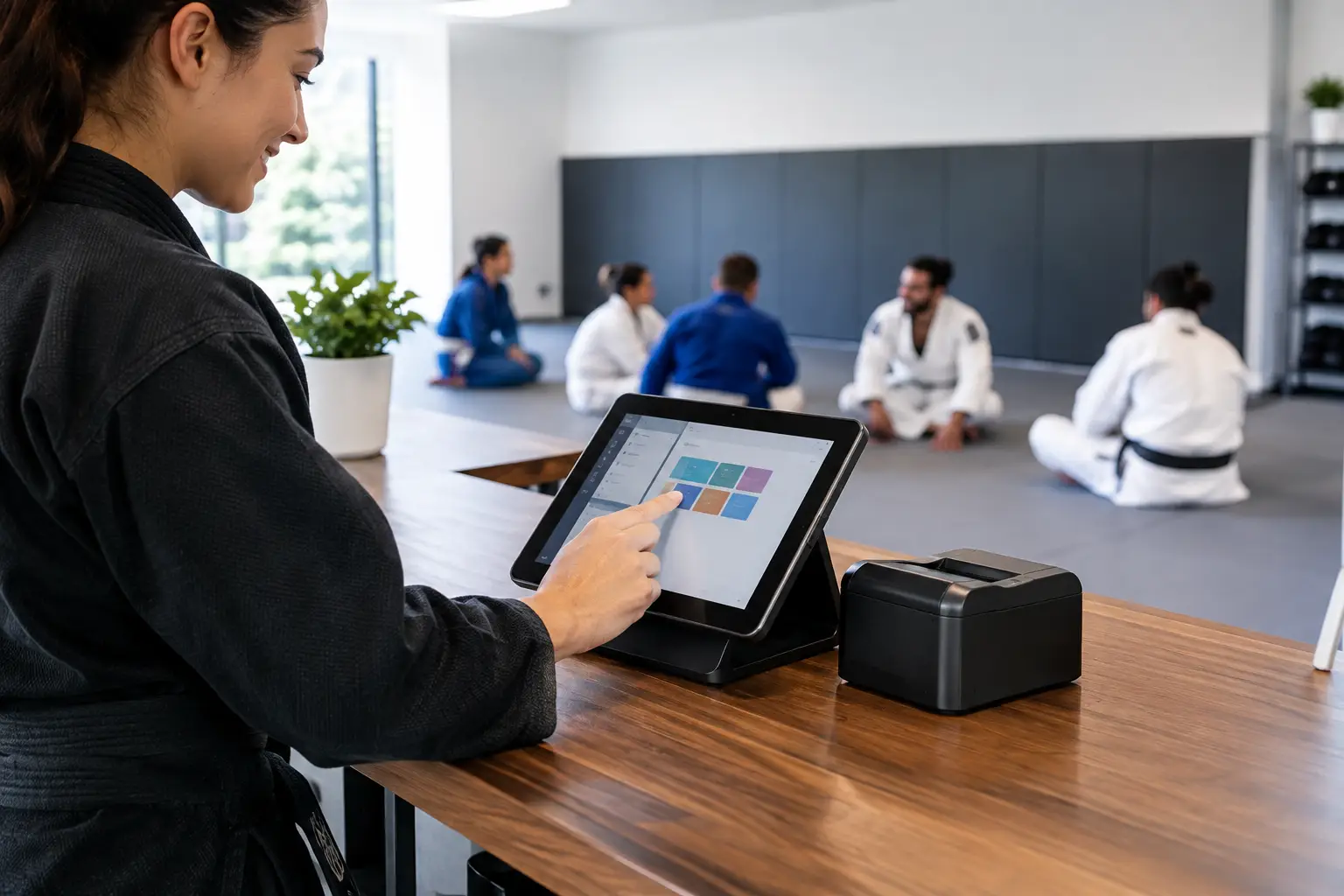
A parent is waiting to pick up a child, the evening class is checking in, and an instructor needs to know whether the no-gi roster is covered. Then someone asks to buy a rashguard and another member says their payment card expired. The best martial arts POS systems handle those moments without forcing the owner to stop coaching and start hunting through three different tools.
For a Brazilian Jiu-Jitsu academy, a POS system is not just a card reader at the front desk. It is the operating layer connecting memberships, family accounts, check-in, waivers, retail sales, program access, and staff accountability. If it only processes payments, it will create more reconciliation work at the end of the month.
What the Best Martial Arts POS Systems Must Handle
A useful system starts with the academy's actual structure. Adult gi, no-gi, kids classes, open mat, private lessons, seminars, and merchandise do not all follow the same rules. A student may be eligible for adult fundamentals but not advanced class. A family may pay from one household account while each child has a separate belt, attendance record, and waiver status.
Generic gym software can often take recurring payments. The problem appears when staff need to answer more specific questions: Is this student enrolled in the right program? Is their waiver current? Can they check into tonight's class during a freeze? Did their household payment fail, and who should receive the notice? Those answers should be visible where staff are already working.
Memberships should control access, not just collect dues
Membership plans should connect directly to program eligibility. A kids program plan should grant access to the relevant kids classes, while an adult unlimited plan can include gi and no-gi. This reduces manual roster cleanup and prevents the front desk from having to interpret exceptions from memory.
Look for support for enrollment changes, freezes, cancellations, and grace periods. A failed payment should not immediately turn into an awkward mat-side conversation. A sensible dunning process gives families a clear window to update payment details before access is restricted, while staff retain visibility into the account status.
The payment processor matters too. An academy should understand where its membership revenue lands, what processing fees apply, and who controls the customer relationship. Systems built around the academy's own connected payment account are generally easier to audit than arrangements that obscure payment ownership or take an extra cut of revenue.
Family billing needs a real household model
Family plans are routine in BJJ, especially in kids programs. Treating every student as an isolated customer creates duplicate invoices, confusing emails, and unnecessary friction for parents. The POS should support a household account with multiple members, one or more responsible payers, and separate student records.
That distinction matters on the mat. Each child needs their own attendance history, rank, stripes, and waiver record. Their parent needs one clear place to review billing, update a card, and manage practical account tasks. Good self-service reduces front-desk interruptions without handing parents control over coaching decisions.
Check-In Is Operational Data, Not a Headcount
A kiosk, portal, or QR check-in option makes attendance more reliable, but the value goes beyond knowing how many people showed up. Attendance data should flow into class rosters, instructor awareness, retention follow-up, and progress conversations.
Check-in rules should be configurable. An academy may allow students to check in only during a set window before and after class. It may need a different flow for seminars, open mat, or visitors. The system should flag restricted access cleanly rather than creating a public confrontation at the kiosk.
For BJJ schools, attendance can also support mat-hour tracking. Mat time is not the sole measure of readiness for promotion, but it is meaningful context. When a coach can review consistent attendance alongside time at rank, competition activity, and technical development, promotion conversations become easier to explain.
Promotion Tools Must Preserve Coach Authority
This is where BJJ requires more than fitness-studio software. Belts and stripes carry weight, and unclear standards can create friction between students, parents, instructors, and head coaches. Software should bring visibility to the process without turning promotions into an automatic output.
The strongest approach is configurable progression by program and rank. Adult gi, adult no-gi, and kids systems should accommodate their own belt structures, stripe policies, age eligibility, and time expectations. A coach may want a view of students who appear ready or almost ready based on the academy's formula. That view is a prompt for review, not a command to promote.
Promotions should remain manual, with a full audit trail. Staff should be able to see who changed a rank, when it changed, and the relevant history. This protects the academy's standards and gives owners a practical way to resolve questions without relying on memory or old group chats.
If an academy operates more than one location, rank records need extra care. Students who cross-train should not have separate or conflicting promotion histories. Shared rank data across linked academies helps instructors work from the same record while keeping the home academy's authority clear.
The POS Should Support the Front Desk and the Mat
Retail is part of many academies, but it should not become a disconnected side business. The system should track inventory for gis, rashguards, belts, patches, drinks, and digital items such as seminar access. Staff need to know what sold, what remains in stock, and whether an item is public or reserved for members.
A connected store also reduces duplicate data entry. If a member buys a gi after class, staff should not have to search for the student in one system and record the sale in another. The same is true for seminar tickets, waiver collection, and one-off charges such as private lessons.
There is a practical trade-off here. A very advanced retail platform may offer deep inventory controls that a small academy will never use. Most BJJ schools are better served by inventory and checkout tools that work cleanly with memberships and student accounts than by enterprise retail features that create training overhead.
Multi-Location Operations Need Consistent Rules
A second location changes the requirements. Owners need local schedules and rosters, but they also need consistent program definitions, billing policies, waiver standards, and rank records. Staff permissions matter more as well. An instructor should be able to confirm coverage for assigned classes without gaining access to sensitive billing or academy-wide settings.
Look for role-based access for owners, administrators, instructors, staff, and students. Also look for a clear instructor workflow. Primary and backup instructor confirmations can prevent the common last-minute scramble where everyone assumes someone else is covering class.
Pricing deserves the same scrutiny as features. Some platforms force schools into higher tiers to access basic operations such as billing, reporting, or multiple programs. Others charge duplicate fees when a student cross-trains between linked locations. A more transparent model scales with active students, includes core functionality at every level, and counts a cross-training student once at their home academy.
How to Evaluate a Martial Arts POS Before You Commit
Do not evaluate a platform from a feature list alone. Run your own workflows through it. Create a household with two kids in different programs. Freeze a membership, fail a payment, and test the grace-period communication. Check in a student at a second location. Process a rashguard sale. Review a student who is approaching promotion eligibility.
Then ask whether your staff can complete each task while class is starting. If the answer requires a spreadsheet workaround, a hidden setting, or an owner-only login, the system will not reduce pressure during a busy evening.
ControleHQ is designed around these connected BJJ workflows: program-based access, household billing, check-in, configurable belt and stripe systems, manual promotions with audit history, instructor confirmation, and academy-managed payment processing. The point is not to automate away coaching judgment. It is to give coaches and operators a dependable record when judgment is needed.
The right POS should make the academy feel more organized to students and less dependent on one person remembering every exception. Start with the workflow that causes the most interruptions now, whether that is family billing, check-in, promotions, or instructor coverage, and choose the system that makes that work clearer on the next busy night.